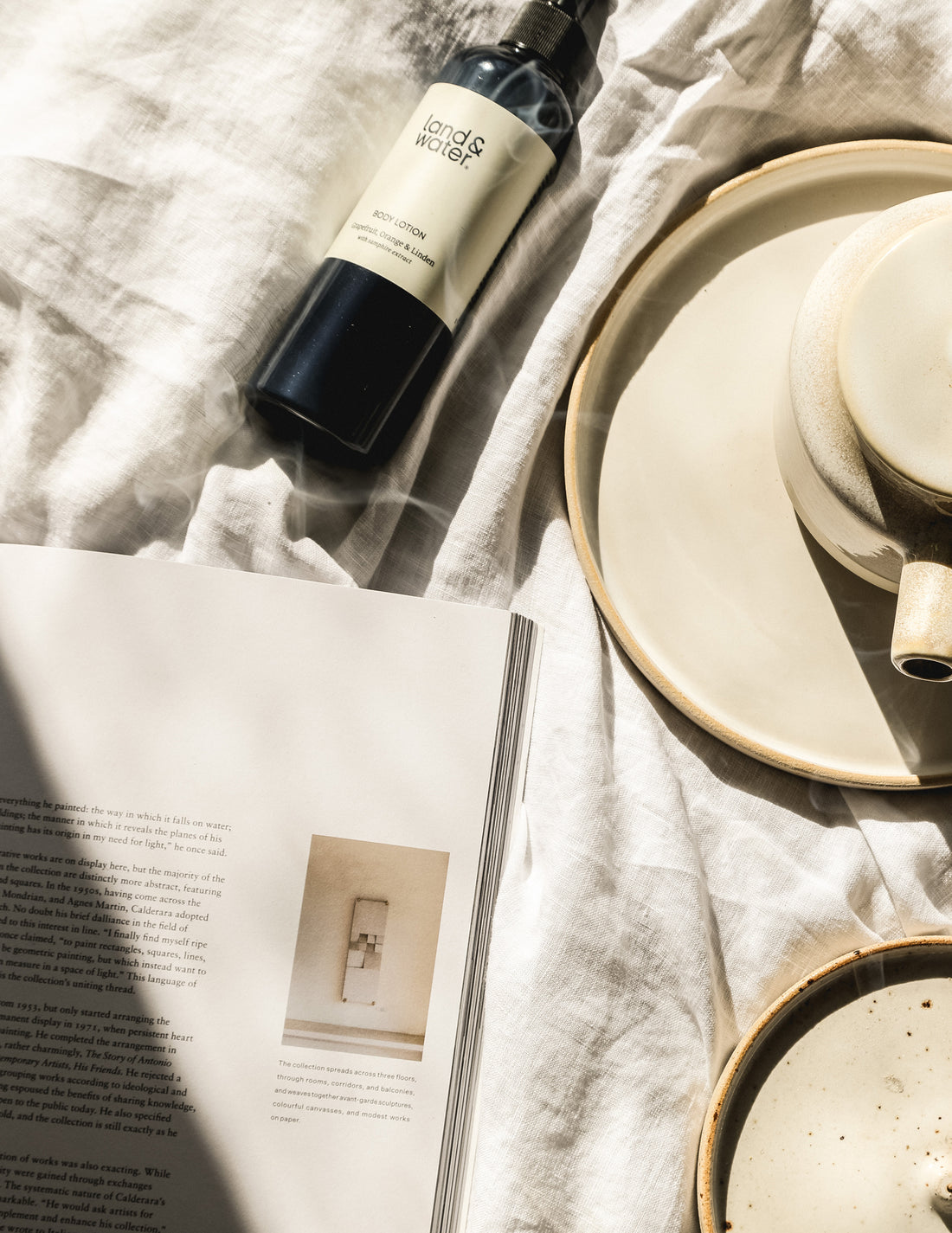
"'Relax' is among the least useful pieces of advice anyone can offer," says Alexander Mackison, designer and owner of Orchard Cottage – a peaceful retreat (and home to land&water collections) in the Cornish village of Golant. "It usually results in the opposite of its aim. Calmness rarely arrives on command, but it is something we move towards gradually."
In this guest blog, we follow Alexander on the gradual drift from chaos to calm, city to countryside, exploring the idea of balance along the way.
Thresholds
I breathe a sigh of relief when the Paddington to Penzance train crosses the River Tamar. I have made it to Cornwall. I'm never completely relaxed on the Great Western Railway, but my mood begins to loosen.
There is a tension between leaving London and arriving in Cornwall. The journey holds me between one condition and another. By the time I arrive, I am more attentive to the landscape, the weather and the different rhythm of life that follows.

Image by @buildingnarratives
I'm aware of more trees and glimpses of the sea. Later, roads narrow and hedgerows rise. The phone signal dips in and out (irritating at first, then liberating). My ordinary life begins to recede.

Image by @buildingnarratives
A sequence of small thresholds concludes with opening the door to Orchard Cottage. Curtains are drawn back, the kettle filled and brought to a whistle. In summer, the patio doors are thrown open to the sea air and the sound of birds. In winter, the fire is lit before I've unpacked.
I have come to realise that relaxation is neither immediate nor fixed. It is assembled gradually through ritual and intention.

Image by @buildingnarratives
Balance
There is a particular balance to the nineteenth-century cottage. Almost nothing is geometrically precise, yet everything feels settled in relation to everything else. Ceilings are low, walls are thick and irregular, floorboards run gently out of level and corners resist perfect right angles. The house feels coherent not because it is perfect, but because its imperfections have accumulated and adjusted to one another over time.

Image by @buildingnarratives
This character is understood physically in the enclosure of a deep window seat, the weight of a door, or the slight change beneath your feet as one floor surface gives way to another. These details are felt before they are consciously understood. They give the house a familiarity that is almost impossible to reproduce. Patina cannot be convincingly applied. It gathers through occupation, repair and use.

A historic house (in my opinion) should not become a museum to its own age, particularly when we are expected to live there, even if only for a few days. Contemporary furniture sits against old plaster, timber and stone without pretending to belong to the same period. The contrast emphasises and enhances each element.

Image by @buildingnarratives
Balance, in this context, is not about making everything agree, but about creating enough harmony for distinct materials, colours and objects to belong together without losing their individual character. The building provides permanence, while curtains, rugs and upholstery introduce comfort. Inherited objects sit alongside newly made pieces.
An interior is richer for allowing these differences to be celebrated.

Image by @buildingnarratives
Between
At one moment, the kitchen-dining space at Orchard Cottage can be overwhelmed by the noise and movement of a dinner party. Drinks are poured. The table is laid as conversations and music compete for attention. Food is shared and plates gradually scatter across the dining table. By the following morning, the same room can appear almost implausibly silent.

 Image by @buildingnarratives
The ability to move between sociability and retreat is one of a house's most important qualities. It offers places to gather, but also places to withdraw. Each state is understood in relation to the other. An animated house gains intensity from the quiet that precedes and follows it. Solitude feels restorative because it comes after company. Neither condition exists entirely on its own, but each gives shape and meaning to the other.

Some houses are designed entirely around serenity and others are so grand that being alone in them feels unnerving. I believe a good house accommodates contradictions. It allows for chaos without demanding it and quietness without imposing it. A house becomes convincing when its occupants feel permitted to disturb it.
Its balance lies not in holding one perfect state, but in moving between many.

Image by @buildingnarratives
ABOUT ORCHARD COTTAGE
Nestled in the peaceful village of Golant on the south coast of Cornwall, Orchard Cottage offers calming elegance and a historic retreat for up to eight people.
Immerse yourself in the restful, timeless interiors. Take a stroll along the oak-fringed estuary of the Fowey River, the dramatic landscape that inspired Daphne du Maurier’s novels. Sip local cider at the village pub. Unwind by the light of the log burner, a land&water candle flickering by your side.
Design by architectureoffice.co.uk